Silo level measurement in Turkish licensed warehouses: the Ministry specification, LİDBİS and TÜRİB SÖS
Turkey's Ministry of Trade has prepared a 3D silo level measurement specification that will soon be mandatory. How data reaches LİDBİS, and what the same system gives the warehouse.
October 6, 2026 · 5 min read · Ada Kurutma · Translation of this article (TR)
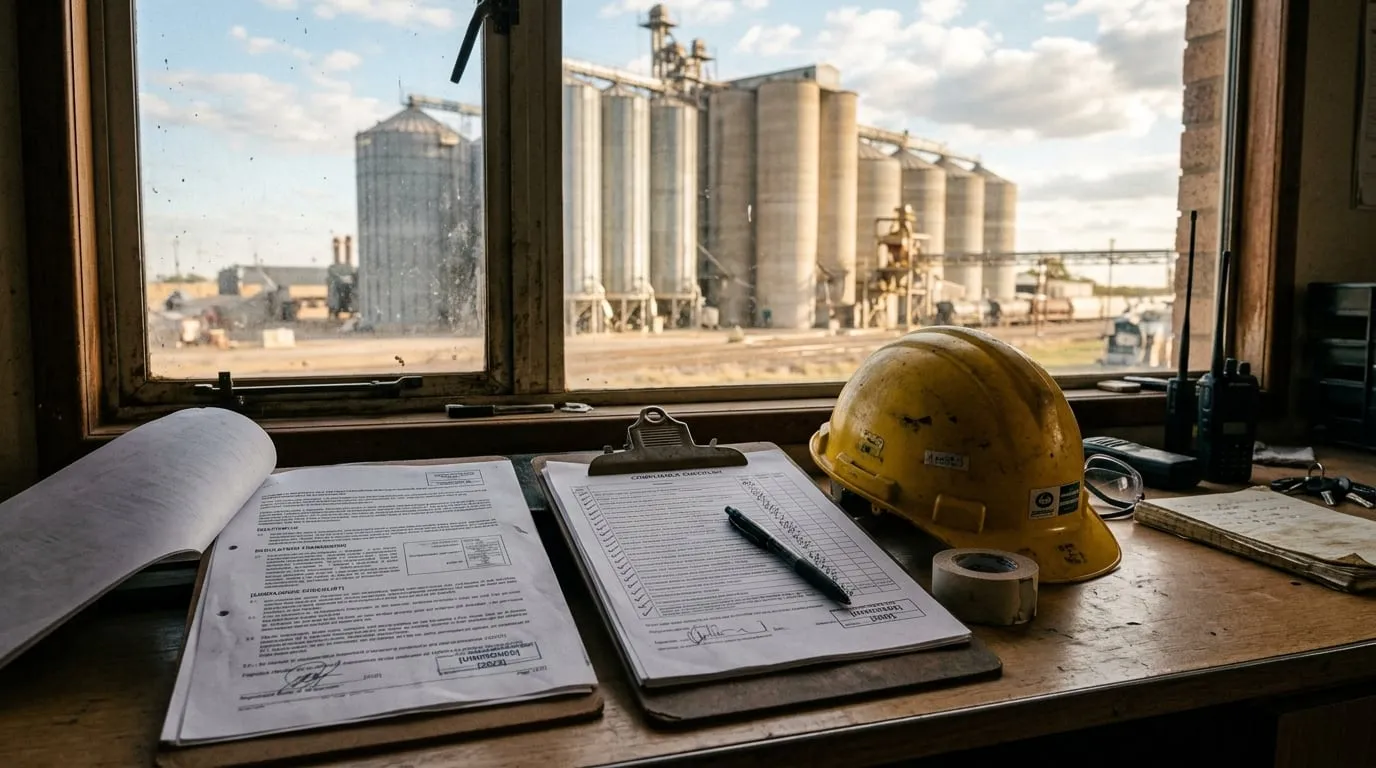
End-of-period stock-take. Early in the morning the branch manager sends two staff up to the silo roof; one opens the hatch and lowers a weighted tape, the other writes figures in a notebook. By afternoon the sums are done: the recorded ELÜS stock and the silo estimate differ by a few hundred cubic metres. Is product missing, or did the crater in the middle throw the reading off? Nobody is sure, and the count runs into another day.
That scene is about to change. Turkey’s Ministry of Trade has prepared a 3D silo level measurement specification for licensed warehouses, and it is expected to become mandatory soon. This article covers the path the data takes, why the measurement has to see the whole surface, and what the same investment gives the warehouse. The binding texts are always those of the Ministry and TÜRİB.
Data enters LİDBİS through TÜRİB’s SÖS
- LİDAŞ: a licensed warehouse operator storing product against electronic warehouse receipts (ELÜS); it may have several branches.
- TÜRİB: the Turkish Mercantile Exchange, where ELÜS are traded.
- LİDBİS: the Ministry’s Licensed Warehousing Information System.
- SÖS: TÜRİB’s Level Measurement System, the gateway through which silo measurements enter LİDBİS.
The chain runs on trust: whoever buys an ELÜS wants to know the product behind it is really in the silo. The device on the silo is the measurable end of that trust; volume, the surface point cloud and event notifications flow from the branch to SÖS.
A single-point level can’t stand up to a stock comparison
The uncertainty in the opening scene comes from the surface shape. A silo filled from the top forms a cone; emptied from the centre, a crater. A level taken at one point doesn’t know the shape and assumes it is flat. In a 22.5 m silo that assumption can cost hundreds of cubic metres; we work through it in one point versus the whole surface.
A volume set beside the records has to be independent of whether the surface is a cone or a crater that day. That is why the regulation points to 3D measurement: points representing the surface are collected and volume is computed from the surface built from them.
The device installed for compliance also works for the warehouse
Treating the specification as a compliance item alone leaves half the investment on the table. In a branch with 3D measurement, the same stock-take goes differently: the manager opens each silo’s latest scan in the panel, sees the tonnage and the last week’s filling and discharge movements. If there is a discrepancy, the list shows which silo and from which date. Nobody climbs the roof.
The panel shows each silo’s 3D surface, movements and a daily summary, on mobile too.
Integration should be proven on a real silo, not on paper
The first question for a supplier is whether it sends data from a real silo to SÖS. Ada Kurutma SiloRadar 3D (model SR3D-80NX) was developed to this specification from the start, and its LİDBİS integration has been validated with a real silo in TÜRİB’s test (UAT) environment: volume, surface point cloud and event notifications are flowing. Go-live depends on the Ministry’s and TÜRİB’s schedule; nothing is waiting on the integration side.
The device scans the surface row by row with a pan/tilt head and completes a pass in about 20 minutes; the dashboard draws the surface as a 3D model of about 1,300 points. The target accuracy on volume is 2%. Sites that do not want to go online get the system on a local server. The panel also feeds the volume and tonnes of every silo to the plant SCADA / PLC over Modbus.
A local counterpart matters most after installation
A measurement system is tested not on installation day but in its third winter. With an imported single-point sensor and foreign software on top, the device maker, the software developer and the people who come on site can be three different companies. With SiloRadar 3D, device, software and panel are developed and built in Turkey.
Ada Kurutma handles installation and service: a Sakarya-based company whose roots go back to Çelik Kardeşler, which started in grain trading in 1953, and which has built grain dryers, storage systems and the SiloSense silo temperature monitoring system under the ADAKURUTMA® brand since 2000. For a warehouse that already bought its dryer or silo temperature system from Ada Kurutma, level measurement joins the same counterpart and the same service network, with on-site response that doesn’t wait for parts from abroad.
Installation doesn’t require emptying the silo
The device is fitted from above through a hole cut in the roof sheet and communicates wirelessly. The silo isn’t emptied and intake and dispatch don’t stop; a branch’s silos come online within days. Local manufacturing and our own service network also bring a clear price advantage over imported systems; we quote by branch and silo count.
In short
- The Ministry’s 3D silo level measurement specification will soon be mandatory; data flows to LİDBİS through TÜRİB SÖS.
- A volume compared with records needs the whole surface measured; the same system serves the warehouse for stock, filling/discharge and stock-take.
- SiloRadar 3D’s LİDBİS integration is validated with a real silo in UAT; installation and service come from Ada Kurutma, in grain since 1953.
To plan compliance and installation for your branches, see our licensed warehouses page.